|
 Psychohistory,
the science of historical motivation, combines the insights of psychotherapy
with the research methodology of the social sciences to understand the
emotional origin of the social and political behavior of groups and nations,
past and present. Then there is
http://www.worldwatch.org/
and
data collections which allows "putting the world on the couch"... Psychohistory,
the science of historical motivation, combines the insights of psychotherapy
with the research methodology of the social sciences to understand the
emotional origin of the social and political behavior of groups and nations,
past and present. Then there is
http://www.worldwatch.org/
and
data collections which allows "putting the world on the couch"...
According to
Asimov's 0th laws of robotics
in
§0,
the ultimate ethical
consideration,
a robot (a
man-made solution)
may not injure humanity,
or, through inaction, allow humanity to come to harm.
Then §1,2,3 are reframed to lie within §0.
As
Asimov's 20,000 year old 4-Law Robot Daneel
Olivaw explained: “The Zeroth Law is a
corollary of the First Law, for how can a human being best be kept from
injury, if not by ensuring that human society in
general is protected and kept functioning?”
In fact
§0 should bring humanity
away
from
ever faster changing trends in in the direction of
sustainable
lifefulfilling
growth:
And yet, because of the
ongoing "success" of
the prevailing system#2,
not even at its abyss, where the
surviving people are faced with "politically correct" suffering do they
become alive again in mourning over the thus lost ones and the damage...
Most people have become
unaware and mindless
like unconscious animals on their
way to the slaughter house
for
the qualitatively far greater sufferings of inhibited lifefulfillment. Thus
"fulfillment" in post-modern times
has become the perfect denial of the truth about the state of the human systems we
are part of. This the state of mind, science has set out to overcame, management
to tangibly improve its danger, and marketing to disseminate the possible progress! In
short, we have come full circle merely on a technologically higher and more
globalized level!
Based on general performance it seems humans
are nothing but recursive, yet self aware, introspective, conscious
machines. To
counter the wave of unease, even terror, irrational but all-pervasive fear
of such, in itself, self-destructive machine like human behavior, Isaac Asimov, the late
Sci-fi writer and scientist invented the Three Laws of Robotics. Since it is
not politically correct to impose solutions on humans, Asimov imposed his
laws on robots which in the end became his solution for
humanity.
The intellect is quick to notice the lack of consistency and the virtual inapplicability of
Asimov's three laws in robotic terms. But how about as a
necessity for man-made solutions?
Admittedly they can not
be negated, but they are not sufficient. First,
applied to robots by Asimov, they do not reflect any coherent
worldview or background. To be properly implemented
technically and to avoid their
interpretation in a potentially dangerous manner the robots in which they
are embedded would have to be equipped with a
reasonably full model of human systems in their
physical and
human spheres of
existence.
Devoid of such contexts, Asimov's laws just as the corresponding intellect, soon lead to
intractable paradoxes
(experienced as nervous breakdown of Asimov’s robots).
Conflicts are ruinous in automata
based on recursive functions (Turing machines), as all robots are. Godel
pointed at one such self destructive paradox
even in the "Principia Mathematica",
ostensibly a comprehensive and self consistent logical system. It was enough
to discredit the whole magnificent edifice of
sumptuous science#1 constructed by Russel and
Whitehead over a decade. That is where post-normal
science#0 got wind of the chance to usurp its
dominance in science.
Some will argue against this and say that robots/the intellect need not be
an automata in the
classical, Church-Turing, sense. That it could act according to
heuristic, probabilistic rules of decision making. There
are many other types of functions (non-recursive) that can be incorporated
in a robot, they will say. True, but then, how can one guarantee the robot's
fully predictable behavior and the intellect's desirable convergence in
society? How can one be certain that the intellectual robots, e.g.
mental operating systems will
fully and always implement the three necessary laws §1-3?
Only recursive systems are predictable in
principle up to the point where their complexity and theirs
required to handle it, makes them incomprehensible.
-
An immediate question springs to mind: HOW will a robot/man-made
system
identify a human being? There are
two ways to settle this very practical issue:
 |
one is to endow the robot with
the ability to conduct a Converse Turing
Test,
|
|
the other is to somehow "barcode"
all non-human and human systems by implanting some signaling device inside them.
|
Both present
additional difficulties. Sigmund Freud said that we have an
uncanny reaction to the inanimate.
This is probably because we know that with our pretensions, traumas and layers of
philosophizing we are nothing but recursive, self aware,
introspective, conscious machines. Special machines, or mental
viruses no doubt, but machines
all the same.
The second law of robotics will prevent the robot from identifying
themselves as humans; unlike the prevailing
intellect which pretends to be the measure in the humanities!
Robots will surely have to be able to identify the like, say a
computer another in a network. But a §1/§2-robot must be capable of making a
§1-non-coercive,
non-intrusive and devoid of
communication or with very limited communication, binary selection.
It will classify one type of physical entities as robots – all the others,
he will group into "non-robots" and among them, beyond monkeys
and parrots, humans to obey to.
Moreover, the
capability to apply
such a test would make a robot human in many important respects.
A human knows other humans for what they are; it takes one to know one, the saying rightly goes.
Let us assume that by some miraculous way the problem is overcome and robots
unfailingly identify humans.
-
The next question pertains to the notion of "injury"
in §1. Is it limited only to
physical injury? Should it encompass the no less serious mental,
verbal and social injuries (after
all, they are all known to have physical
side effects which are, at times, no less severe than direct
physical "injuries")? Is an insult an
injury? What about being grossly
impolite, or
psychologically abusive? Or
offending religious sensitivities,
being politically incorrect -
are these injuries?
Practically all human actions
actually offend someone, or have the potential to do so, or
seem to be doing so. Consider surgery, driving a car, or investing money in
the stock exchange. These "innocuous" acts may end in coma, an accident, or
a stock exchange crash respectively. Should a robot
refuse to obey human instructions
which embody a potential to injure said instruction-givers?
 Which level of
risk should trigger the refusal program? At which stage of
collaboration should it be activated? Should a robot refuse to bring a stool
to a person who intends to commit suicide
by hanging himself? Should he ignore an instruction to
push someone off a cliff (definitely), help him climb the cliff (less
assuredly so), get to the cliff (maybe so), get to his car in order to drive
him to the cliff... Which level of
risk should trigger the refusal program? At which stage of
collaboration should it be activated? Should a robot refuse to bring a stool
to a person who intends to commit suicide
by hanging himself? Should he ignore an instruction to
push someone off a cliff (definitely), help him climb the cliff (less
assuredly so), get to the cliff (maybe so), get to his car in order to drive
him to the cliff...
Where do the responsibility and obeisance bucks stop?
Whatever the answer, one thing is clear: a robot must be equipped with
more than a rudimentary sense of judgment,
with the ability to appraise and analyze
complex situations, to predict the future and to base his
decisions on very fuzzy algorithms (no programmer can foresee all possible
circumstances). To most people such robot/arguments towards solutions sounds much
more dangerous than any machine ar weapon
they know
which do not behave in accordance with §1-3.
-
Moreover, what, exactly, constitutes "inaction"?
How can we set apart inaction from failed
action or, worse, from an action which
failed by design, intentionally?
If a human is in danger and the robot tries to save him and fails – how will
we be able to determine to what extent it
exerted itself and did everything it could
do?
-
How much of the responsibility
for the inaction or partial action or failed action should be attributed to
the manufacturer – and how
much imputed to the robot itself? When a robot decides finally to
ignore its own programming – how
are we to gain information regarding this momentous event? Outside
appearances can hardly be expected to help us distinguish a
rebellious robot from a
lackadaisical one.
-
The situation gets much more complicated when we consider
states of conflict. Imagine that
a robot is obliged to hurt one human in order to prevent him from hurting
another. The Laws are absolutely inadequate in this case unless the robot
either establish an empirical hierarchy
of injuries and/or an empirical hierarchy
of humans. Should we, as humans, rely on robots or on their
manufacturers (however wise, moral and compassionate) to make such selection
for us? Should we abide by their judgment
– which injury is the more serious and warrants an intervention?
One of the possible solutions,
the one Asimov pursued in his psychohistory is
|
to introduce gradations,
a
probability calculus, or a
utility calculus. As phrased by Asimov, the rules and conditions
are of a threshold, yes or no, take it or leave it nature.
|
|
Another, that
robots
begin to instruct themselves with §0 to assume the responsibility to maximize overall
utility, especially for borderline cases which could lead to harm
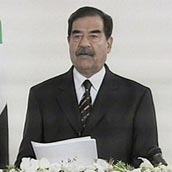
for mankind. After 9/11 George W. Bush began to address this
problem in respect to Saddam Hussein and
Kim Jong Il.
|
|
Still,
even the introduction of heuristics, probability, and utility cannot resolve
all human dilemmas: Life is
also about inventing new rules on the fly, as we go, and as we
encounter new challenges. Robots
and mental operating systems with rigid instruction sets are ill suited to cope with
live, for in fact they diverge to globally destructive systems!
|
In short §1-3 are irreducibly
necessary and in their insufficiency
lead to §0,
which upon globalization in turn reveals that
human systems, beginning with the intellect
and the resulting collective systems#2,
are in themselves always closed and
thereby self-destructive.
|
The fact, that there is an innate
urge in all humans not to give in to their thus
"sinful" nature of their own "creation". It points,
though
without §-proof, to
a higher order based on a Creator with
a personal interest
as Maintainer and Redeemer
in our lifefulfillment!
And this is more than a mere sublimation of the fear of death. This in turn should make us
put our mental operating system on the couch of our
conscience and this is what
Applied
Personal Science#3 APS®
is all about.
|
§0 in this
world
|